
Awards night is over. The last trophy has been handed out, the dessert plates are scattered, and the room has a decision to make: stay, chat, or quietly slip toward the exit. That moment is where your entertainment budget either earns its keep or becomes a line item nobody remembers. The right corporate acts can turn a seated, slightly restless crowd into an engaged room. The wrong one can leave everyone watching the clock.
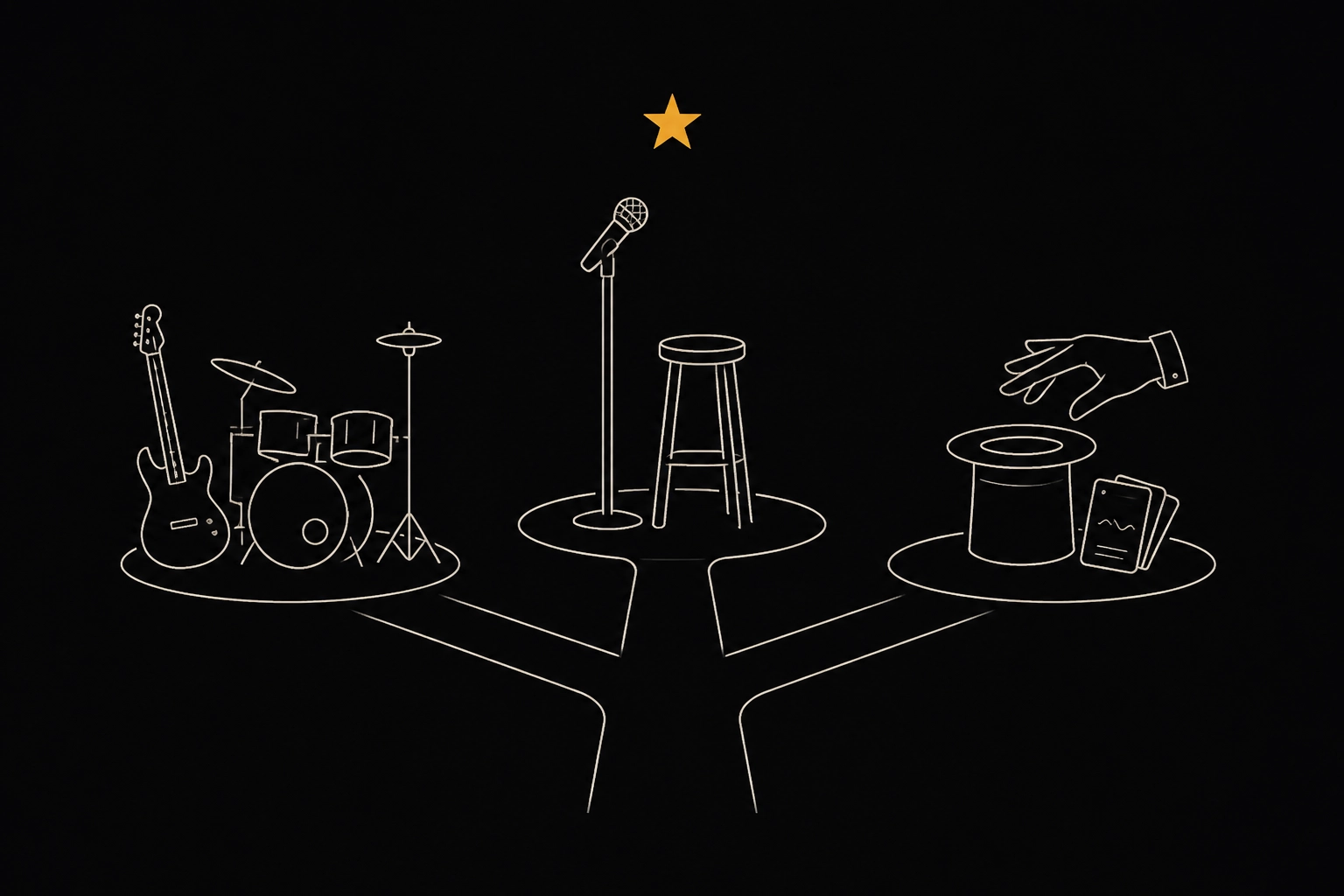
So let's treat booking entertainment as an engagement decision, not just another vendor cost. We'll look at why the act matters after the awards, what a seated awards-night room actually needs, and how a band, a comedian, and a stage mentalist each change the energy. A band or comedian performs at the audience; a stage mentalist performs with them, which is often why interactive formats stick in delegates' minds. You'll also get a side-by-side on participation, staging, and run-of-show fit, roving entertainment ideas for pre-dinner and cocktails, and a practical checklist for choosing your gala act. By the end, you'll know how to match the act to the room so the night wins.
Why the Act Is an Engagement Decision, Not a Line Item
Most gala budgets treat entertainment as the last line item to tick off. Yet the act decides whether 300 people stay in the room, talk to each other, or drift toward the bar.
The EIC 2026 study with Oxford Economics puts business events at 1.65 billion participants in 2025, US$1.8 trillion in supported GDP and 24.2 million jobs. Verify that figure against the full report; the same release also uses billion-dollar wording.
Practically, every awards dinner is a room that has sat through speeches, a three-course meal and 14 category announcements. Attention is finite, and you have spent most of it by the time dessert lands.
In Andy Nunn's professional observation from working corporate rooms, a band or a comedian performs at the audience, while a stage mentalist performs with them. The interactive formats tend to be the ones delegates bring up the next morning, though that is practitioner experience, not research.
Your job is to match the act type to the room, the seating, the run-of-show and the participation level you want. Whether you are booking corporate entertainment in Sydney or a national conference in Auckland, Sydney organisations are already raising the standard for what a room expects.
What a Seated Awards-Night Room Actually Needs After the Awards
The formalities are done. Winners have their photos, the dessert plates are cleared, and 300 people are seated at round tables in low light. The room is either ready to lift or about to slide into small talk. That gap is what the act has to work with.
Three jobs, really: wake the room without embarrassing it, give each table something to talk about, and send people out on a high rather than a slow shuffle to the car park.
Then the physical realities. A long narrow ballroom, sight lines blocked by a head table, a "stage" that is really a dance floor, and a PA designed for background music rather than a five-piece band. Those constraints rule acts in and out before you get to talent.
Which is why participation level is the most useful filter. A room that has sat passively for two hours often needs an act that invites them to do something, not another 45 minutes of watching.
Run of show matters too. Awards run long. The act needs a format that can start late, absorb a delayed dessert service and still finish strong before the first wave of departures.
A band, for instance, solves the energy problem but rarely the participation one.
The Band: Rousing, Reliable, and Sometimes Easy to Ignore
A band is the most reliable way to fill a dance floor. Booked as the closing segment of the night, it gives the event a natural crescendo: awards done, jackets off, everyone up. At a trade-show function where guests are standing, drinking and mingling, a band supplies atmosphere without demanding attention.
Seated at a gala dinner, though, the picture changes. For anyone at the back tables, a band is essentially well-dressed background music. Volume, genre and familiarity decide whether people get up or simply keep talking over the top of it.
Logistics deserve their own conversation before you book: footprint, load-in time, power requirements, and the sound limits your venue will actually enforce. The HSE recommends average audience levels no louder than 107 dB, and readings near the stage often run higher. Confirm the set list suits a mixed-age corporate room rather than a wedding crowd.
Participation is mostly passive until the dance floor opens, which matters if your delegates are flying out early the next morning.
Best fit: the engine of a corporate party entertainment segment or an after-awards celebration. Less effective as the centrepiece while everyone is still seated, finishing coffee.
The Comedian: High Reward, High Risk in a Mixed Corporate Room
Comedy runs on different fuel. It works best in a relaxed, alcohol-friendly room where people already know each other and the culture tolerates a bit of edge.
The risk sits in what you cannot control: the mood on the night, the client's tolerance, and whether the audience shares the same references. A set that kills in one workplace can misfire in a conservative boardroom or a mixed-industry conference. In the UK, for example, jokes and pranks can count as harassment even when unintended (Acas).
Briefing matters more than the set list. Agree guardrails in writing before the night: no industry inside jokes that isolate guests, no individual callouts, no sensitive topics negotiated on stage. As with any speaker, Align the Speaker With Your Audience pays off before the contract is signed.
Participation profile: the comic talks at the room and reads the room, but the audience mostly laughs. That is reactive, not active. It is a different engagement texture from an interactive act.
Verdict: strong for corporate party entertainment where the tone is loose and the audience is one workplace. Riskier at award nights with mixed guest lists, senior clients and a formal run of show.
The Stage Mentalist: Performing With the Room, Not At It
If comedy is a gamble on the room's mood, mentalism is a bet on its curiosity. The trick isn't reading minds. It's revealing how they work. Mentalism runs on psychology, perception, suggestion, misdirection and carefully built illusion. No supernatural claims, no mind-reading powers, just a structured experience that shows how easily attention and assumption can be steered.
At a gala, that means volunteers from the audience, objects and details offered by guests, predictions sealed before the evening began, and the whole room leaning in because someone at table 12 is involved. Nobody gets humiliated. The setup is small, the content is tailored and corporate-safe.
This lands differently at work because guests don't hear about cognitive bias, they experience it, then watch their own assumptions bend in real time. It's a natural bridge to the keynote work About Andy Nunn does on leadership, decision-making and navigating change.
Best fit: awards nights, gala dinners and conference plenaries where you want the room involved, not just entertained. Hey! I'm Andy. I deliver stage mentalism and keynote speaking from Sydney across Australia and New Zealand.
Side by Side: Participation, Staging and Run-of-Show Fit
Ratings below are editorial judgement from working corporate rooms, not research findings.
Band | Comedian | Stage mentalist | |
|---|---|---|---|
Participation level | High atmosphere, low direct participation until the dance floor opens | Medium, through laughter and crowd work | Highest, guests volunteer, choose and react |
Setup footprint | Larger; power, soundcheck and load-in time | Minimal | Small |
Run-of-show flexibility | Low; tied to set times | Medium; depends on room mood | High; timing flexes around late awards |
Seated gala suitability | Strong closing segment | Workable in a relaxed room | Built for it |
Mixed-guest awards night | Fine | Risky; humour relies on shared references | Works across mixed tables |
What the audience does | Listens, then dances | Laughs and responds | Takes part, then compares notes |
Many corporate event entertainment Sydney briefs are solved with a combination: roving mentalism or a solo act through pre-dinner drinks, then a band once the dance floor opens. The interactive segment does the warming and connecting first, so the band inherits a room already talking to itself.
Want that participation without the footprint? Andy Nunn delivers stage and roving mentalism across Australia and New Zealand. Enquire about an event or workshop and the format gets shaped around your run of show.
Roving Entertainment for Pre-Dinner and Cocktail Segments
It's why the combination often starts before anyone sits down. Roving entertainment moves through the crowd during drinks, networking or pre-awards arrivals, so guests meet each other and the room lifts before the first entrée lands.
It works especially well at trade-show functions and networking drinks, where the standing-with-a-drink phase can stall. A roving act gives strangers a reason to talk and creates small shared moments around the room that carry into dinner.
Logistics matter more than most planners expect. Work out guests per performer, noise levels, indoor or outdoor conditions, and how the segment sits against the welcome speech. If a band is soundchecking in the same space, sequence the two so they don't compete.
In Sydney, this format suits harbour-side venues, hotel ballrooms and convention centre foyers, where guests arrive in waves and seating may not start for an hour.
Andy Nunn's roving mentalism sits alongside close-up magicians and roaming musicians as an option for corporate entertainment in Sydney. The difference is that mentalism gives guests something to test and discuss rather than simply watch. If that suits your pre-dinner segment, enquire about roving mentalism.
A Practical Checklist for Choosing Your Gala Act
Roving covers the arrivals hour. For the main segment, run the brief past four filters.
Audience. One workplace or many industries? Seniority mix, age spread, and how much the bar has been involved all change what lands. If delegates have flown in and want an early night, a long seated set will empty the room.
Room. Seated rounds or standing cocktail? Check sight lines past the head table, stage size, venue sound limits, load-in access and curfew. A five-piece band needs a footprint and a power supply that a hotel ballroom may not offer.
Run of show. Awards always run long. Confirm your act can start late, absorb a delayed dessert service and still finish hard on time. Ask whether it needs a soundcheck or rehearsal window.
Outcome. Do you want a dance floor, conversation starters, or an experience that reinforces a conference theme about decision-making, perception or change? Pick accordingly.
For anything interactive, send the brief to Andy Nunn and enquire about stage mentalism, roving mentalism or an interactive keynote. The format gets shaped to your room, run-of-show and audience rather than fitted in around it. The same logic applies when hiring a keynote speaker in Sydney.
Match the Act to the Room and the Night Wins
You have the checklist. Now comes the judgement call.
Treat that entertainment line as an engagement decision, not a line item. What you book after the awards decides whether the room watches, participates or quietly drifts toward the car park.
Choose the band when atmosphere and a dance floor are the goal, the comedian when you have one relaxed workplace audience and a clear content brief, and an interactive act when you want the whole room in on it.
The distinction that matters is performed at versus performed with. In Andy Nunn's experience working corporate rooms, interactive formats are the ones delegates still mention the next morning.
Plan around your room and your run of show, not the act's promotional video. Brief any act properly on your audience, your content boundaries and your timing.
Want the room involved rather than merely entertained? Make the ideas an experience. Enquire with Andy Nunn about stage or roving mentalism for your gala, awards night or trade-show function, or an interactive keynote that gets people thinking about perception, decision-making and change. Match the act to the room, and the night looks after itself.
Conclusion
The right gala act is not a line item. It is an engagement decision that shapes how the room feels after the awards. A band can lift the atmosphere, a comedian can land when the audience and brief are right, and a stage mentalist can turn a seated crowd into participants. The winning choice depends on your room, run of show, and appetite for interaction. Remember the core distinction: performed at versus performed with.
Use the checklist, then trust your judgement. Brief the act properly. Plan around your audience, not a promotional video. If you want the room involved rather than merely entertained, enquire with Andy Nunn about stage or roving mentalism, or an interactive keynote. Match the act to the room, and the night will look after itself.